
An inverted chastity cage is a cage built to hold the penis inward, toward the body, instead of letting it extend forward inside a tube. That one structural difference is what separates it from the traditional cage most people picture first. Product listings use several names for this idea — inverted, negative, reverse, inward — and they don’t always use those words the same way, so the construction described on each product page matters more than the label.
This guide covers what the design actually is, how it works, how it compares with traditional and flat cages, and the details worth checking before you buy one.
What Is an Inverted Chastity Cage?
In a traditional cage, the penis sits inside a cage body that extends outward from the base ring. An inverted cage removes most or all of that forward space. The cage body sits close against the ring, and the penis is directed back toward the wearer’s body, held in a compact shell, plate, or recessed pocket instead of a protruding tube.
The terms you’ll see while shopping describe the same general direction. “Negative” and “reverse profile” both point to this inward arrangement. Retailers and manufacturers use the words loosely, though. Two products both labeled “negative” can differ in how deep the recess is, where the opening sits, which ring shapes they use, and what’s included in the box. Treat the name as a starting category, then compare the written specifications.
How Does an Inverted Chastity Cage Work?
Every chastity cage needs two working parts: something that anchors behind the penis and scrotum, and something that encloses the penis. In an inverted design, the anchor is still a base ring (or occasionally a belt-supported setup), but the enclosure faces the body.
In practice that means the cage body is short, the internal space points backward, and there’s usually a front opening sized for urination. Because there’s no long tube adding length, the whole assembly projects much less from the body. Fit still depends on the same basics: ring diameter, the shape of the ring, and the internal dimensions of the cage body — which is why two “compact” models can still fit completely differently.
A real product makes this easier to picture than a definition does.
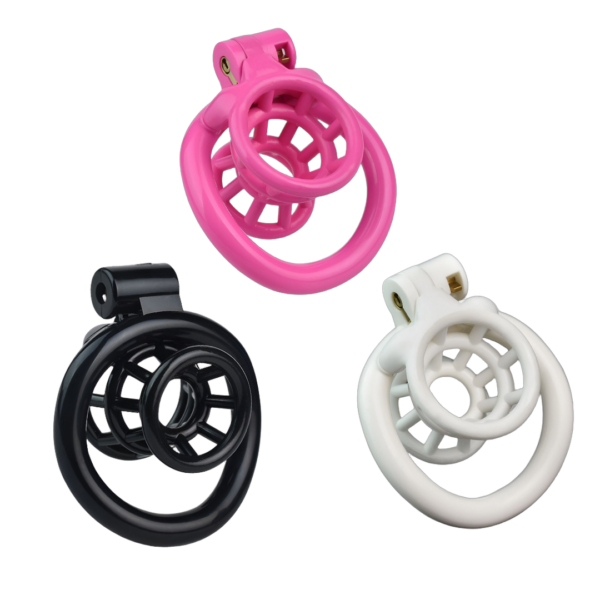
3D Printed Negative Chastity Cage with 4 Rings
This is a good first example because the photo shows the whole idea at once: a flat, open-grid shell sitting close to the base ring rather than a tube sticking out in front. The product page documents the details that actually decide fit — the cage dimensions, the four included ring sizes, and the Black, White, and Pink color options. Reading those numbers against your own measurements tells you more than the word “negative” in the name ever will.
View the 3D Printed Negative Chastity Cage →
Inverted vs. Traditional Chastity Cages
Here’s how the two broad designs compare. These are general patterns — specific models vary, so check each product’s own specifications.
| Inverted (reverse-profile) | Traditional cage | |
|---|---|---|
| External profile | Compact; the cage body sits close to the base ring | Cage tube extends forward from the ring |
| Cage shape | Recessed shell, plate, or short pocket facing the body | Elongated tube or mesh enclosure |
| Fit and measurements | Internal depth and ring diameter carry most of the fit | Tube length and diameter matter alongside the ring |
| Typical materials | Stainless steel, resin, and plastic — all common, depending on the model | Same range; material follows the product, not the category |
| Visibility under clothing | Typically less forward bulk; how discreet depends on clothing and build | More forward projection to cover |
| Locking and parts | Usually a lock plus keys; some add straps or removable inserts | Lock, keys, and sometimes multiple rings or spares |
Inverted vs. Flat Chastity Cages
Flat cages get mentioned alongside inverted ones because both keep the profile low, but they’re not the same design. A flat cage compresses the penis against a plate or shallow front with minimal forward space. An inverted cage directs it inward into a recessed pocket. The distinction gets blurry in products that combine both ideas, and some listings belong in both categories.
We cover that comparison — profile, structure, ring configurations, and which to look at first — in a dedicated article: Inverted vs. Flat Chastity Cages.
Common Inverted Chastity Cage Materials
Material follows the product, not the category, so this is a summary rather than a rule.
- Stainless steel: rigid, smooth, and easy to clean; heavier to wear. Some products specify a grade like 304 stainless steel — only trust a grade when the product page states it.
- Resin: common in 3D printed cages; light, rigid enough for the compact shell shapes, and often sold in several colors. Listings usually name the resin type (nylon resin, ABS resin, natural resin).
- Plastic and other materials: some models use other polymers or mixed constructions; check the individual product page for what’s actually documented.
One resin example from the shop:
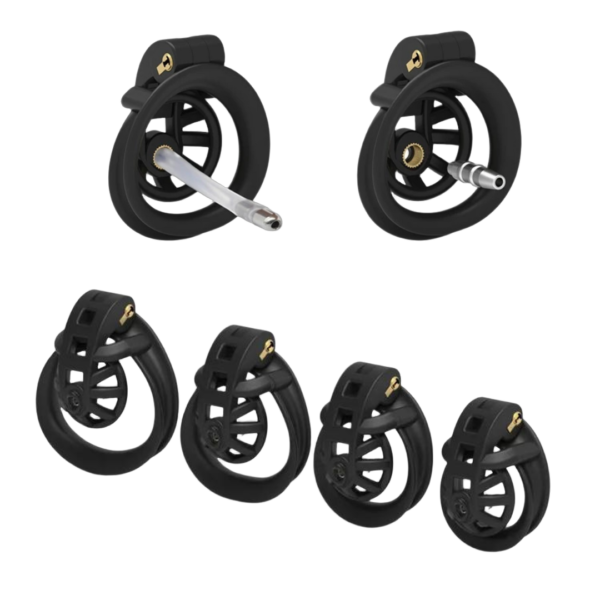
3D Printed Resin Micro Negative Chastity Cage with Urethral Tube
The reason to look at this one here is the material data. It’s a 3D printed nylon resin build with a listed weight of about 105g — exactly the kind of concrete number that makes material comparisons real instead of theoretical. The page also offers positive and negative cage configurations and a choice of metal or silicone urethral tube. Inserts like that involve additional care and their own research, so treat them as a separate decision rather than a bundle.
For a full material comparison — weight, rigidity, finish, cleaning, and how each affects everyday wear — read Metal vs. Resin Inverted Chastity Cages.
What Measurements Matter?
Three groups of numbers decide whether an inverted cage fits:
- Body dimensions: the cage’s listed length, width, and internal depth, including how the product defines each measurement.
- Ring diameter: the inner diameter of the base ring, usually offered in several sizes. This is the measurement most worth getting right.
- Profile: how far the assembly sits off the body, which is the number the inverted design is meant to shrink.
The Size Guide explains how to take these measurements before you order.
Models list these numbers differently, and a metal example shows the habit to build:
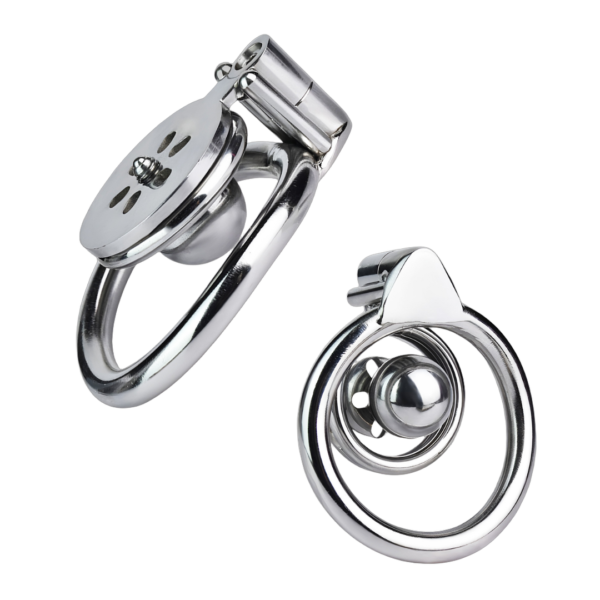
Micro Negative Inverted Chastity Cage
On this product page the facts sit in separate line items: a 304 stainless-steel body, four base-ring sizes (40, 45, 50, and 55mm), and an optional adjustable PU belt that is clearly listed as an add-on rather than part of the base package. Reading ring sizes, materials, and optional parts as separate facts is exactly what prevents ordering the wrong thing — and it’s a different structure from the resin examples above, which is why it closes out this set.
Who Might Consider an Inverted Design?
From a product-selection point of view, an inverted cage usually makes sense when:
- You want the smallest forward profile possible under clothing.
- You’ve tried tube-style cages and found the extra length unnecessary or uncomfortable for how you wear one.
- You’re comparing low-profile options generally — flat and inverted models both belong on that shortlist.
None of that makes inverted “better.” A traditional cage still suits plenty of wearers, and the right answer is the model whose dimensions and configuration match you. If persistent pain, numbness, significant swelling, discoloration, or broken skin shows up with any device, stop using it and sort out the fit before continuing.
What to Check Before Buying
Before adding any inverted cage to your cart, run it against a short checklist: documented dimensions, ring sizes, material as written on the product page, what the package actually includes, and which components are optional. Our choosing checklist walks through all seven checks with examples.
Frequently Asked Questions
Is an inverted chastity cage the same as a flat cage?
No. Both are low-profile designs, but a flat cage presses the penis against a plate, while an inverted cage directs it into a recessed pocket. The full comparison breaks down the differences.
What does “negative” mean in product names?
It refers to the same inward, reverse-profile family of designs. Because the term isn’t standardized, use it to find candidates and the product specifications to make the decision.
Are inverted cages made of metal or resin?
Both, depending on the product. Steel and resin versions each have trade-offs in weight and feel — see Metal vs. Resin.
Will an inverted cage be invisible under clothes?
The forward profile is typically smaller than a traditional cage’s, which usually makes it easier to cover. How discreet it ends up being depends on the model, your build, and what you’re wearing.
How do I know which size to get?
Start with the base-ring measurement and compare it to the sizes each product offers. The Size Guide covers how to measure.
When you’re ready to compare real models, browse the Inverted Chastity Cage collection — every listing shows its own dimensions, ring options, and package contents.