
Picking the right chastity cage size is less about Small/Medium/Large labels and more about three numbers: the cage length, the inner diameter, and the base ring. Products on this site — and across the market — label and measure these differently, so two listings that look similar can fit completely differently. This chastity cage size guide covers what each measurement means, how to take your own numbers, and how to read a product page before you order. Where a specific product’s size diagram defines a measurement its own way, that product page is the authority.
The Three Measurements That Matter Most
| Measurement | What It Tells You | What to Check on the Product Page |
|---|---|---|
| Cage length | The space available inside the cage | Internal or usable cage length, and where the diagram starts and stops |
| Inner diameter | The width inside the cage | Internal diameter — not outside width, not circumference |
| Base ring | How the cage is supported at the base of the body | Inner ring diameter, plus the ring shape where it’s selectable |
Some products add their own variables — a cage-to-ring gap or spacer, a strap with a waist range, an adjustable ring. Treat those as extra fields to check, not as things every listing has. If a page doesn’t state one, it isn’t there.
What You Need Before Measuring
Gather a flexible measuring tape (or a non-stretch string you can measure against a ruler), the size chart or specification of the product you’re considering, and a note to work in millimeters — that’s the unit nearly every listing uses, and it keeps comparisons clean.
Measure relaxed. Stand normally, don’t compress yourself to chase a smaller number, and take each measurement more than once, ideally on different days. A single reading has enough natural wiggle to move you half a ring size in either direction.
How to Measure Cage Length
Cage length corresponds to your length when relaxed and soft, plus a little room — not anything measured erect. Hold the tape along the top from the base to the tip without pressing in, and write down what you get across two or three attempts.
The catch is on the product side: a listing’s “cage length” doesn’t always mean the same thing as the next listing’s. One page’s number may cover the usable internal space; another’s may include structure you can’t occupy. Before comparing two products, find where each size diagram starts and stops. If a product’s diagram defines its length differently from anything you’ve read here, the diagram wins.
How to Measure Inner Diameter
Inner diameter is the usable width inside the cage — measured across the opening, wall to wall, on the inside. It’s not the outside diameter (which includes the shell’s thickness), not the circumference, and not the base ring diameter. They get confused constantly, and the confusion is expensive.
If what you have is a circumference, the arithmetic conversion is: diameter ≈ circumference ÷ 3.14. That’s the math, nothing more. Whether the converted number suits you still depends on the cage’s shape, its internal contour, and the product’s stated dimensions — a round number for an oval body is only a starting point. Compare your converted figure against the internal diameter the listing actually states.
How to Measure Base Ring Size
The base ring sits behind the scrotum, and its size is given on listings as an inner diameter in millimeters. Your measurement, taken with a soft tape or non-stretch string at that position, will naturally be a circumference — so convert once: estimated diameter = circumference ÷ 3.14. For example, 141mm around works out to roughly 45mm across. Then match that against the ring sizes the product offers.
Ring shape is the part people skip. Round, oval/arc, and curved rings at the same nominal diameter sit differently — the same 45mm number distributes contact differently in each shape. Where a product offers a choice of ring styles, treat shape as part of the sizing decision, not a cosmetic one, and confirm the shape on the specific product before ordering.
A ring set makes the whole question easier to live with. One product that demonstrates why:
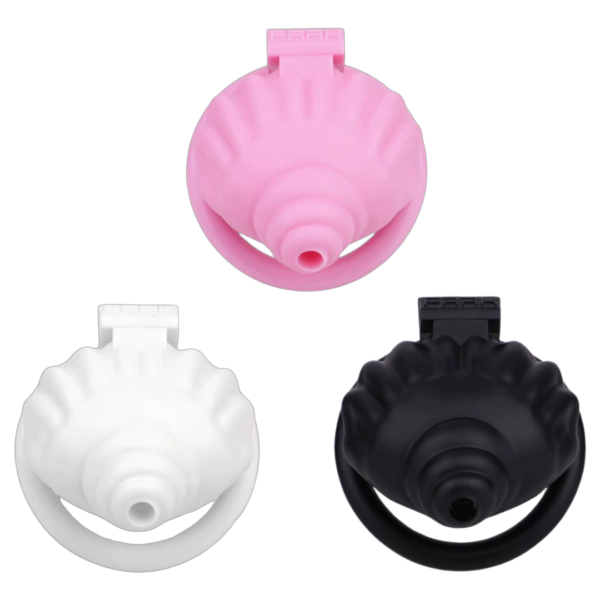
ABS Small Shell Chastity Cage Set with 4 Rings – Pink / Black / White
This set ships with four ring sizes — 40, 43, 46, and 50mm — so your converted estimate gets checked against hardware instead of defended on paper. The shell is a compact ABS resin design in three colors, with an optional nylon strap for supported wear. It’s a useful template for reading any multi-ring listing: compare your number to the range, not to a single size.
Cage Length vs Total Length
This is the comparison that quietly ruins size decisions. Cage or usable length describes the space you actually occupy — the internal body of the cage. Total length may include the lock, the connector, the base assembly, or the outer shell on top of that. Two listings with the same “total length” can enclose noticeably different internal space.
So don’t judge internal room by total length across products. When a page gives both numbers, the gap between them is the hardware; when it gives only one, check which one it is before you use it. The inverted cages on this site make the distinction especially visible — their forward dimensions are minimal, which is why inverted chastity cages are sized primarily by depth and ring rather than by tube length.
How to Read a Product Size Diagram
Before trusting any number from a product page, walk it through this order:
- Label first. Cage length, total length, internal depth — which is it?
- Trace the arrows. Where does each measurement start and stop?
- Internal or external? Diameters especially — the inside is what you occupy.
- Diameter or circumference? If the label is ambiguous, the number’s size usually gives it away (a “45” is a diameter, a “141” is a circumference).
- Your selected variation. Ring, strap, or cage-style choices can change what ships.
- Included base ring. Several sizes offered doesn’t always mean several rings in the box — read the package contents.
- Included accessories. Straps and tools may be standard or optional.
- Standard or optional. Anything described as optional is a separate choice, not a default.
The rule underneath all eight: use each measurement as the product states it. Don’t quietly convert it, round it to match another product, or reuse a number from a similar-looking item — similar-looking cages are not the same cage. For the full step-by-step routine, see how to measure for an inverted chastity cage in our guides section.
Sizing an Inverted Chastity Cage
Inverted cages can look barely there — a compact shell with no forward tube, sometimes with a name like “micro” or “negative” on top. None of that tells you the size. The photos show the design’s idea, not its dimensions, and the label words describe direction and style, not millimeters.
What to read instead: the internal dimensions of the inverted section, the base ring size and shape, any plug or insert the configuration includes (measured separately, with their own fit questions), any strap with its waist range, and the exact configuration you’ve selected. A concrete example:
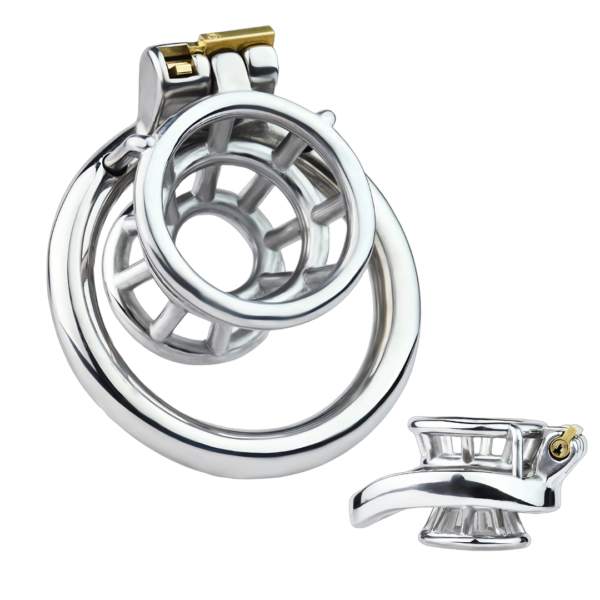
Metal Inverted Chastity Cage Stainless Steel Negative Chastity Device
Read this listing for its ring structure: four sizes (40, 45, 50, and 55mm) with a choice of arc or round ring styles — diameter and shape as two separate decisions on one page. That’s exactly the pair of numbers an inverted design lives or dies on, since the compact shell leaves the ring doing most of the anchoring.
Sizing a Flat Chastity Cage
Flat cages share the low front profile, and that’s where the similarity ends — flat designs vary in usable internal space, width, and overall profile just like any other family. A short front doesn’t tell you the internal dimensions any more than “flat” does.
Check each listing for the same three numbers as everywhere else — usable space, ring size and shape, width — plus the configuration you’re selecting. Browse the flat chastity cages collection and you’ll see the range for yourself.
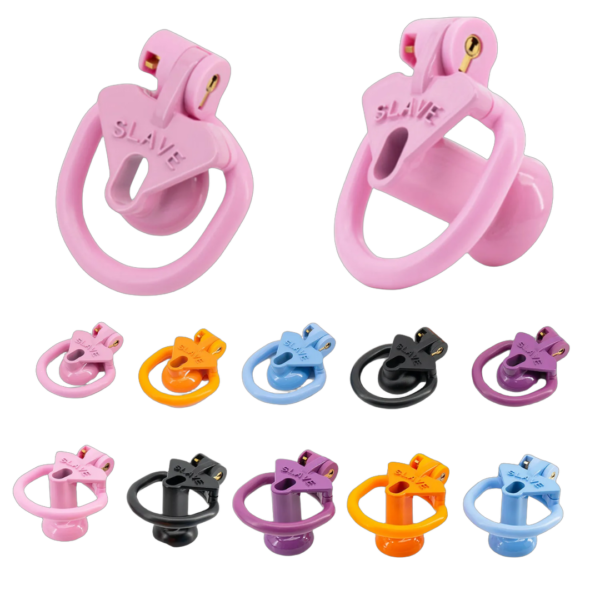
Slave Flat / Negative Chastity Cage with 4 Rings – Multicolor
A flat listing that rewards careful reading: short and long cage styles share the page with four included base rings (42–52mm) and five colors. Same profile family, different internal space per style — the exact reason “flat” can’t be treated as one size.
What About Small or Micro Cages?
“Small,” “mini,” and “micro” are marketing size classes, not standards. One product’s micro is another’s small, and none of the words promise specific millimeters — the same goes for “flat” and “negative.” Judge by the listed dimensions, never by the adjective. One product makes the point neatly:
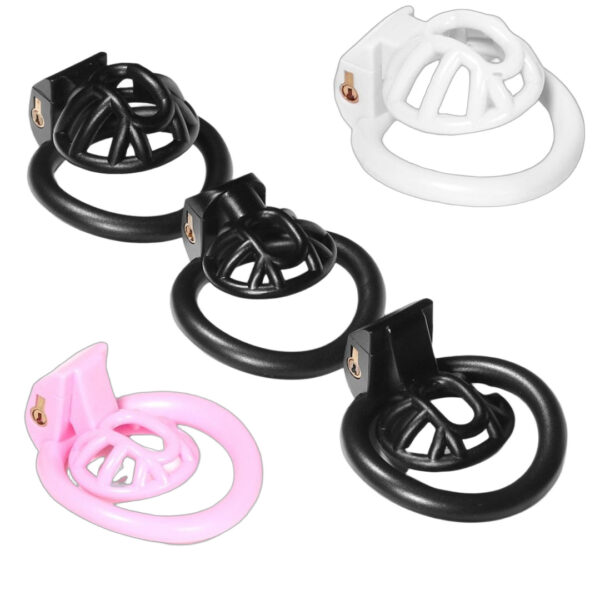
Pink Small Sissy Chastity Cage With 4 Base Rings – Micro / Negative / Stub
Three cage styles — Micro, Innie/Negative, and Stub — selectable over the same four included base rings. Three different “sizes,” one ring set, one listing: the words describe shapes, and only the dimensions describe space. For more options in this family, browse small chastity cages.
Common Chastity Cage Sizing Mistakes
Choosing by “S / M / L” alone
Size grades aren’t consistent between products — one brand’s M is another’s S. The letters are a starting filter; the measurements are the decision.
Confusing circumference with diameter
Around and across differ by a factor of π. Divide 3.14 once, on paper, and never mix the two in a comparison.
Using cage diameter as ring diameter
The cage’s inner width and the ring’s inner diameter serve different jobs. Substituting one for the other produces a confident, wrong order.
Comparing total length with usable length
One includes hardware; the other is what you occupy. Cross-comparing them ranks products by their locks, not their space.
Assuming similar-looking products share sizes
Measurements belong to the product they’re printed on — never borrowed from a lookalike.
Ignoring the selected variant
Your ring, strap, or cage-style selection can change what arrives and even the dimensions that apply. Confirm the configuration, then confirm what that configuration includes.
Assuming smaller is always better
Below a certain point, “compact” turns into compression — a too-small cage is a fit problem, not a discretion win. The smallest size that matches your measurements is the right size; smaller than that isn’t.
Fit and Comfort Checks
A correctly sized cage shouldn’t cause persistent pain, numbness, cold skin, marked discoloration, or significant swelling. If any of those show up, remove the device and recheck the fit — usually the ring — before the next wear. This is sizing guidance, not medical advice; for symptoms that persist or concern you, a healthcare professional is the right next step.
Frequently Asked Questions
How do I know what size chastity cage I need?
Take three relaxed measurements — base circumference at the ring position, soft length, and width — convert the circumference to diameter (÷ 3.14), and match the results against the product’s own size chart. Labels and measuring points vary between products, so always check the listing’s diagram before ordering.
Is cage length the same as total length?
No. Cage or usable length is the space you occupy; total length can include the lock, connector, and base assembly. Compare like-for-like, and check which one a listing actually states.
How do I calculate ring diameter from circumference?
Divide the circumference by 3.14. For example, a 141mm base measurement converts to roughly 45mm. It’s a pure math conversion — the final choice still depends on the ring sizes offered and the ring’s shape.
Is cage diameter the same as base ring size?
No. The cage’s inner diameter is the width inside the cage body; the base ring’s inner diameter is the anchor that sits behind the scrotum. They’re measured at different places and serve different jobs — both need checking against your numbers.
Should I choose the smallest chastity cage possible?
No. Past the point where “compact” matches your measurements, going smaller just creates pressure, pinching, and circulation issues. Discretion comes from the right size worn correctly, not from the smallest box on the page.
Do flat and inverted cages use the same measurements?
The measurements are the same — ring size, usable space, width — but the emphasis shifts: inverted designs lead with internal depth and ring, flat designs with front dimensions and ring. Labels can differ between listings, so the product’s own diagram is the tiebreaker.
If a product’s size diagram, measurement labels, or package configuration is unclear, send the product link and the variation you’re considering to contact@inverted-chastity.com before ordering — don’t guess. For broader comparisons beyond sizing, our guides section covers designs, materials, and configurations.