
External cage length and internal usable depth describe different distances. External length follows the outside of the device between the stated endpoints; internal depth describes space inside a defined part of the cage. You cannot substitute one for the other, even when both are written in millimeters.
Follow the arrows, not just the label

| Measurement | Endpoints to identify | Common mistake |
|---|---|---|
| External overall length | The stated outside rear reference point to the furthest included front point. | Assuming the entire distance is usable space. |
| Internal usable length or depth | The specified inner opening or reference plane to the inner limit. | Including wall thickness, a lock or an outside projection. |
| Front profile or projection | The stated reference plane to the exterior front surface. | Treating a low profile as proof of a particular internal depth. |
“Length” and “depth” are not standardized enough in product titles to resolve an unclear drawing. An inverted cage may have several relevant dimensions, and a flat cage may also contain an inward-facing section. First identify the two endpoints and the direction of the measurement, then compare the number.
Why two similar numbers may not be comparable
Imagine one drawing labels 35 mm across an exterior side profile, while another labels 35 mm between two internal surfaces. The numbers match, but the measured spaces do not. Wall thickness and projecting components are part of the first measurement only if its arrows include them. This is an illustrative comparison, not a specification for two interchangeable products.
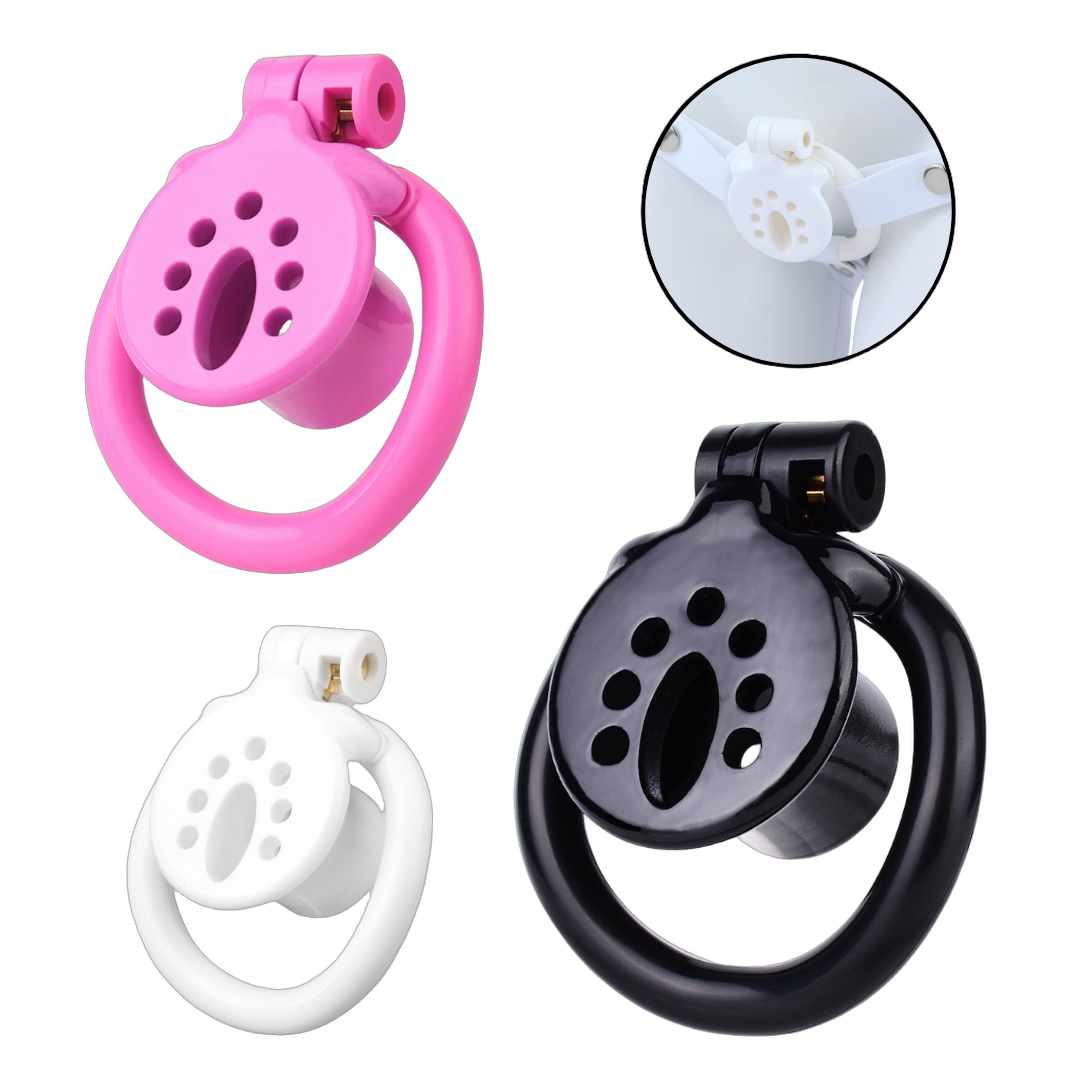
Flat Inverted Chastity Cage with 4 Base Rings and Adjustable Strap
The gallery for this four-ring model includes a side-view dimension of 35 mm. That external annotation should not be described as 35 mm of internal usable depth. Use the diagram to ask which surfaces the arrow connects, rather than estimating internal space from the exterior photograph.
When the product image is unclear
- Find the original-size chart in the product gallery.
- Check whether the arrows touch internal surfaces, external surfaces or an undefined reference line.
- Record the number and unit together with those endpoints.
- If either endpoint is unclear, ask for a defined measurement. Do not scale a photograph or subtract a guessed wall thickness.
The size chart guide covers other labels that can be confused. The separate depth measurement guide focuses on recording a defined dimension; this page explains why the dimensions differ.
Does a shallower cage necessarily fit better?
No. Shallower, flatter and smaller describe aspects of geometry, not a comfort ranking. Ring shape, openings, clearances and individual anatomy also matter. A dimension comparison is useful only when the endpoints match, and it cannot replace a fit assessment or justify painful pressure.