
Hinged describes a ring that opens at a joint; fixed-loop describes a ring without that opening mechanism. Round, oval and arc describe shape, not whether a ring opens. Neither mechanism alone establishes comfort, fit or an adjustable size.
Where the mechanism changes the inspection
| Part of the ring | Hinged mechanism | Fixed-loop construction |
|---|---|---|
| Opening | A designed joint permits opening. | No opening joint is assumed; verify the actual construction. |
| Closure contact | Inspect the joint, mating edges and fastening. | Inspect seams, perimeter and the cage connection. |
| Size | The closed geometry still needs a defined measurement. | The inner geometry still needs a defined measurement. |
| Failure concern | Binding, damaged closure or unexpected play. | Cracks, deformation or damaged connection. |
A hinge can introduce an additional closing seam and moving interface. That does not make every hinged design easier to use, nor does a fixed loop remove all contact or release concerns. Do not force either mechanism or modify it to accommodate an unsuitable dimension.
What the current catalog evidence supports
The reviewed product descriptions primarily name ring sizes and shapes. They do not establish a clearly documented hinged model for this comparison. It would be misleading to label an arc-ring product hinged—or to certify it as a fixed loop—based only on the option name.
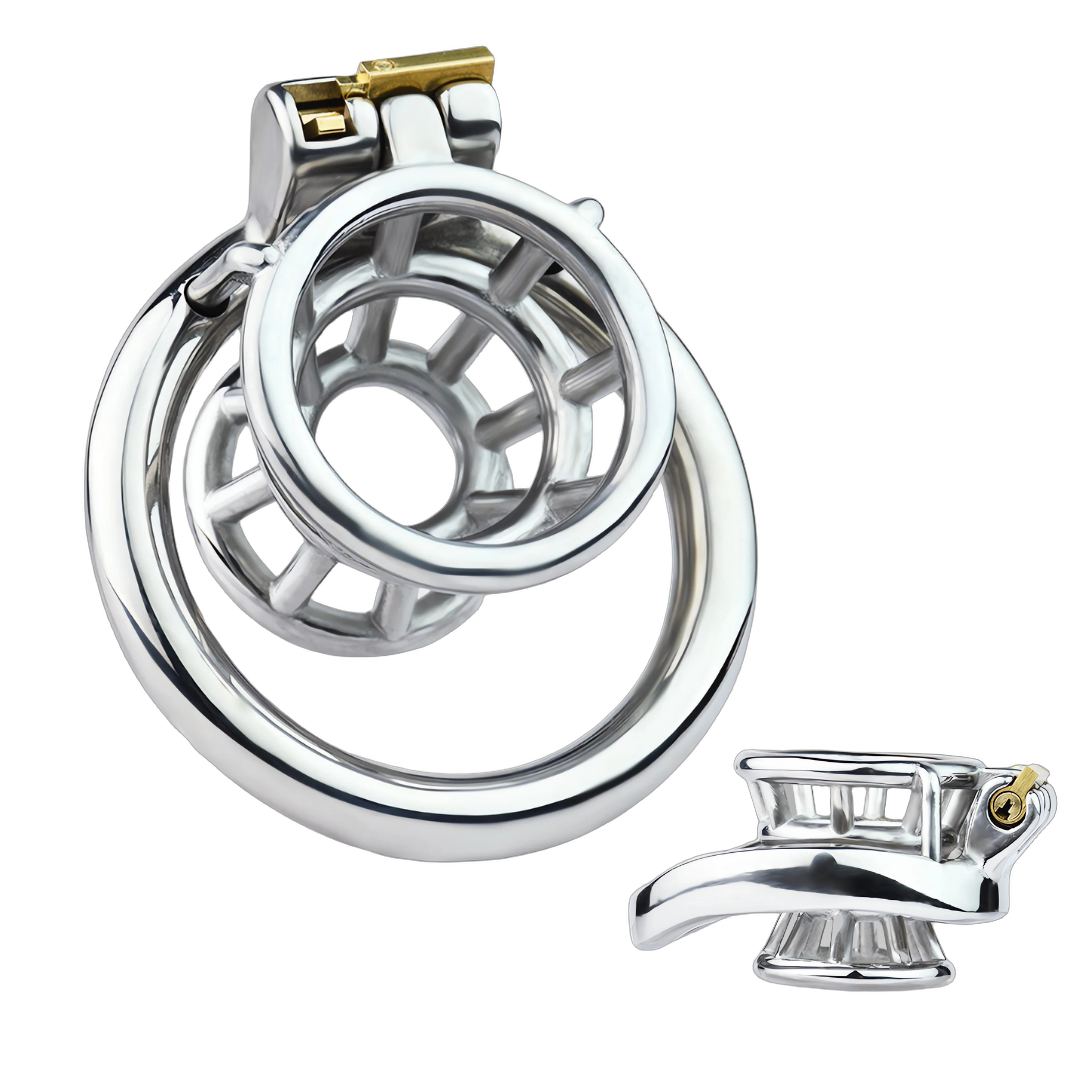
Metal Inverted Chastity Cage Stainless Steel Negative Chastity Device
This model offers arc or round rings with 40–55 mm size choices. Those are shape and size labels, not an explicit opening-mechanism specification. If the mechanism matters to your decision, ask about the exact ring construction and release arrangement rather than interpreting the selector as proof.
Questions to resolve before choosing
- Does this exact ring open, and which joint or closure is designed to do so?
- How is the closed inner measurement defined?
- What model-specific connection joins it to the cage?
- What normal release method is documented?
- Which edges and moving parts should be inspected before use?
Use hardware inspection for damaged joints and closures, ring-shape terminology for geometry and ring-size selection for measurement. Keep a missing mechanism specification unresolved rather than turning a generic concept into a product claim.